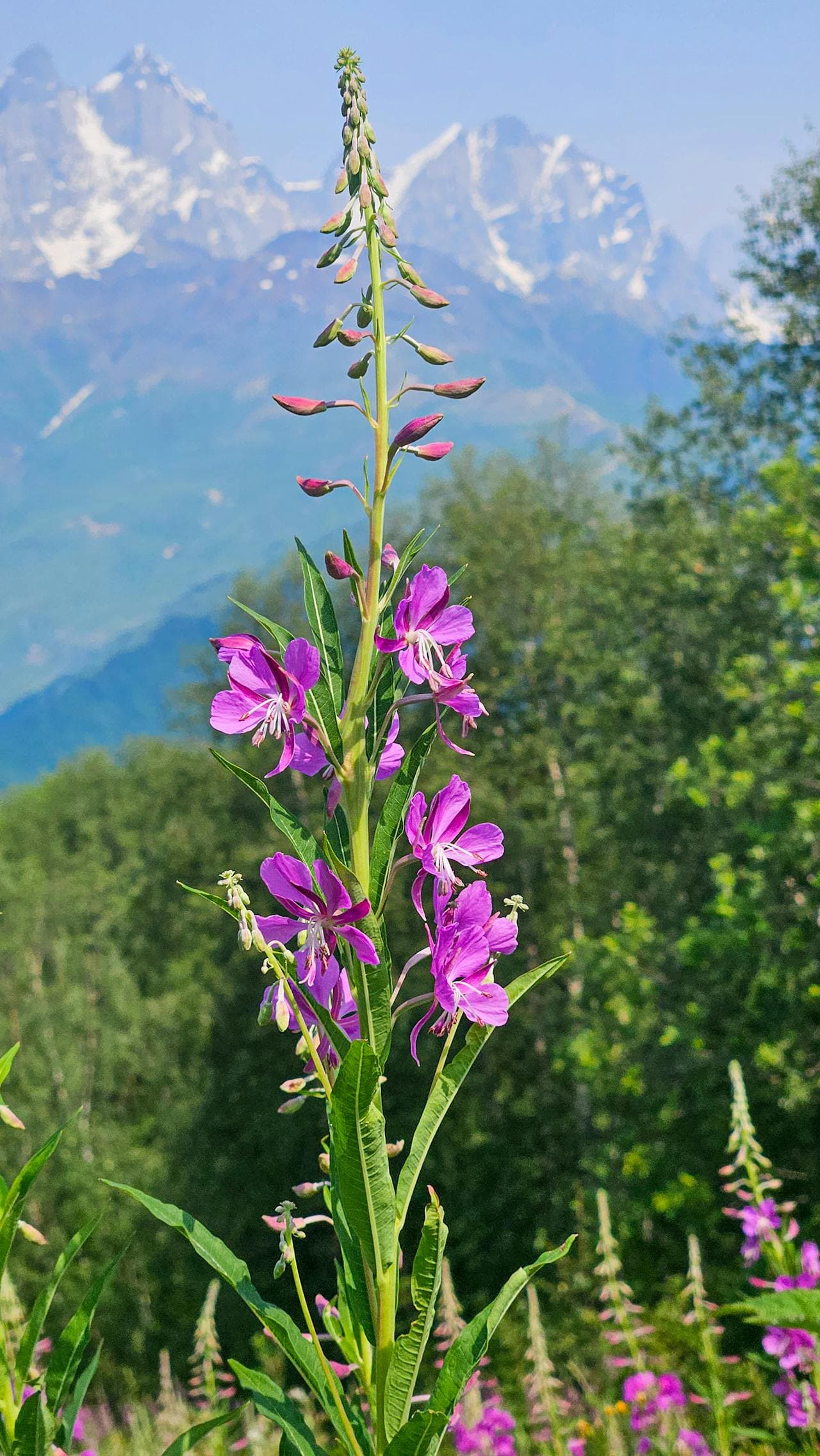
The Name
“In Plains Cree, iskotewask names the plant by its relationship to fire. Iskotew means fire. The word does not describe the flower. It describes what the flower answers.”
Pioneer Species
How to answer a fire
Wildfire clears the canopy, opens the soil, and burns off the plants that would compete for light. Most of the forest treats this as loss. Fireweed treats it as an invitation.
Its rhizomes lie deep enough to survive the heat. Its seeds, blown in from kilometres away on silk parachutes, land on the freshly bared mineral soil they need. Within one growing season the black is gone. In its place, a haze of magenta.
- ◆
Deep rhizomes, survive the surface heat of most wildfires.
- ◆
Latent buds, resprout within weeks, sometimes days, of a burn.
- ◆
Windborne seeds, arrive from adult plants kilometres away.
- ◆
Mineral soil, the exposed ground fireweed prefers over litter.
- ◆
Full sun, no canopy, no competition, no shade.
London, 1940 onward
The summer London’s ruins turned magenta
From September 1940 through May 1941, German bombers struck London night after night. When the raids finally slowed, the city stood pocked with more than a thousand bomb craters and thousands of blocks of shattered brick. It was, briefly, a burned landscape in the middle of a capital.
The following summer, magenta appeared. Not in gardens. In craters. In the rubble of demolished terraces. Along the twisted iron of collapsed roofs. The tall, purple-pink spikes of rosebay willowherb, a wildflower Londoners had until then thought of as a country plant, had colonised the ruins.
The city gave it a wartime name: bombweed. It appeared in newspapers, in cartoons, in the diaries of children who watched it grow. To a population living through the rebuild, the flower on the ruins carried weight far beyond its size.
Sir Edward Salisbury, Director of Kew Gardens
“It has become, in the course of a few summers, the characteristic plant of the ruins. Where there was a house, there is now a garden of rosebay willowherb.”
Salisbury and other botanists surveyed London’s bombsites through the 1940s, documenting the plant communities that returned to a burned city. Fireweed, they wrote, was everywhere.
After the Burn
A plant with a habit of showing up
1980
Mount St. Helens
One of the first vascular plants photographed inside the blast zone. Seeds drifted in on the wind and germinated in ash. Within a few summers, magenta ran through what had been grey.
1986
Chernobyl exclusion zone
Fireweed was among the successful re-colonisers of the abandoned countryside around the reactor. The plant reads catastrophe as opportunity, and radiation levels change the ecology, but not the answer.
every summer
Boreal Alberta
The summer after a wildfire in Alberta’s northern forests, whole hillsides turn magenta. It is the province’s single most reliable signal that a place has burned and is coming back.
Every ruined place fireweed has been asked to answer, it has answered.
Farther North
A calendar you can read at sixty miles per hour
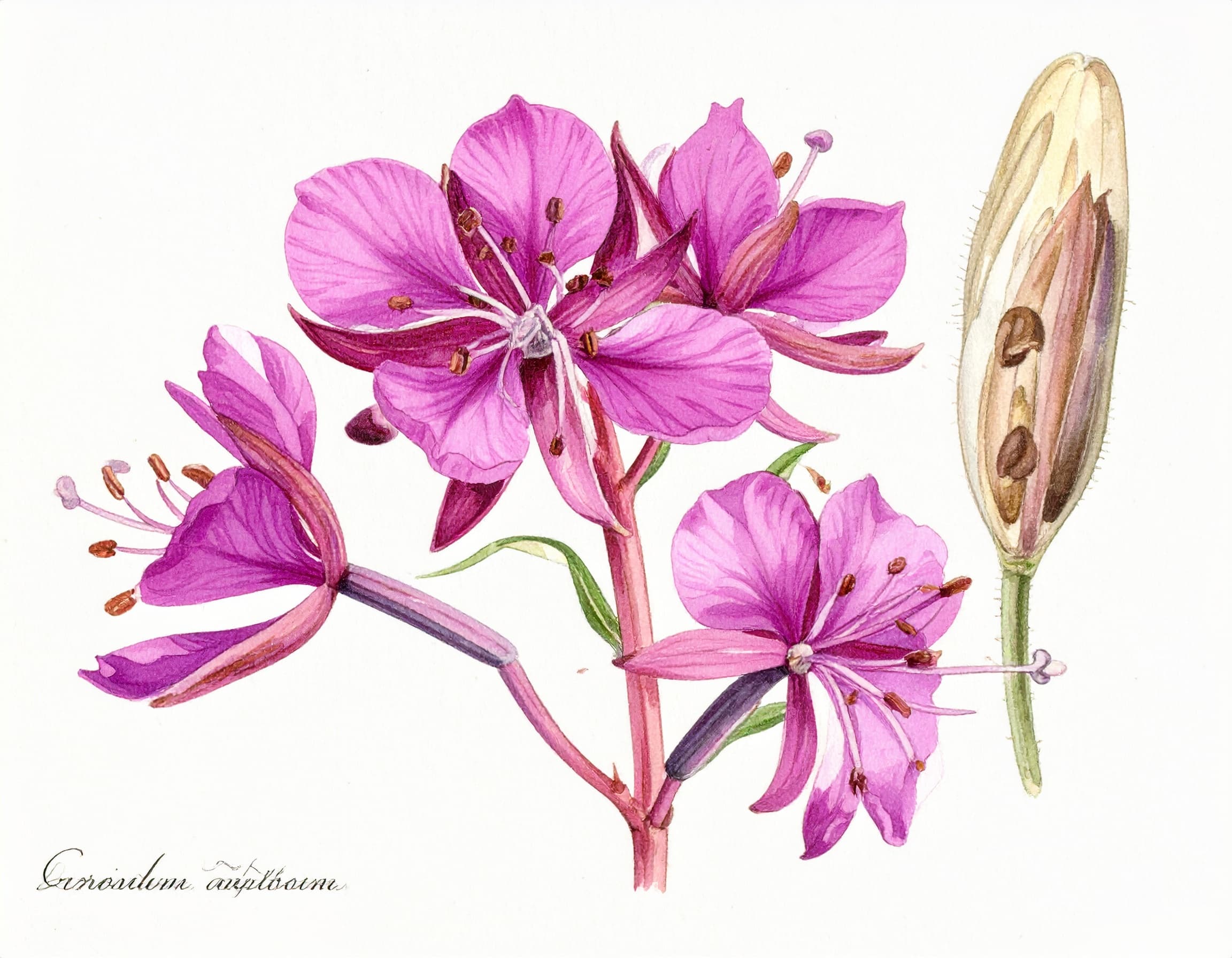
Yukon’s territorial flower. Adopted in 1957. In the north, fireweed is not a wildflower among others. It is the wildflower. Roadsides, riverbanks, cutlines, and burn scars turn the same colour at the same moment every year.
The stalk as a clock. An old northern saying: when the last flowers reach the top of the stalk, summer is six weeks from ending. The bloom moves upward as the season closes down, and generations of northerners have watched it happen.
Grows farther north than most flowers. Fireweed thrives well past the treeline. It flowers in the short arctic summer, sets seed, and lets the wind carry it toward next year’s bare ground. Few flowering plants push this far into the cold.
A wildflower whose job is not decoration but repair, whose bloom is a countdown, whose seeds ride the wind further than most people travel in a summer.
For anyone who has stood in a burned place
and watched, the summer after,
the ground come back magenta.