Common Houseplant Pests: Identification, Treatment & Prevention
Quick Care Summary
Every houseplant keeper eventually deals with pests. They hitchhike in on new plants, arrive on cut flowers, drift in on a breeze from an open window. The key is catching them early — a ten-bug infestation is an afternoon of work; a thousand-bug infestation is a month. Here’s how to identify the six most common culprits, stop them, and keep them from coming back.
Universal first response
Before you treat anything, take the plant to the shower or sink and rinse leaves (especially undersides) with room-temperature water. This alone eliminates 50–80% of a light infestation for most pests. Then isolate the plant from others while you treat, inspecting nearby plants daily.
1. Spider mites
What you see:Fine pale stippling on leaf tops, faint webbing in leaf axils and on leaf undersides, increasingly dusty/dull appearance. Mites themselves are less than a millimetre — barely visible as moving specks. A magnifying glass confirms.
Who they target: Love dry air and warmth. Peak season in Alberta is mid-winter indoors when humidity drops. Especially bad on Calatheas, palms, ivy, and fiddle leaf figs.
Treatment:Shower rinse weekly, then spray all leaf surfaces (especially undersides) with insecticidal soap or a 1:10 neem oil solution. Repeat every 4–5 days for 3 weeks to catch hatching eggs. Raise humidity (mites hate it). For severe infestations, consider a pyrethrin-based spray.
2. Fungus gnats
What you see:Tiny black mosquito-like flies that puff up from the soil when you water. Larvae live in the top 2–3 cm of soil and eat organic matter plus young roots.
Who they target: Any plant in consistently-moist soil. Nearly universal in houseplant collections. More nuisance than threat unless populations explode.
Treatment:Let soil dry out fully between waterings for 3–4 weeks — larvae die in dry soil. Cover soil surface with 1 cm of horticultural sand or perlite to deter egg-laying. Yellow sticky cards trap adults. For heavy infestations, drench soil with a solution of BTI (Bacillus thuringiensis israelensis, sold as “Mosquito Bits”) — kills larvae without harming plants.
3. Mealybugs
What you see: Small white cottony tufts clustering in leaf axils, at stem joints, and on leaf undersides. A waxy coating protects them from most sprays. Sticky honeydew below the plant; sometimes black sooty mould on leaves.
Who they target: Succulents, orchids, and foliage houseplants — especially Hoyas, jade plants, and African violets.
Treatment:For small infestations, touch each mealybug with a cotton swab dipped in 70% isopropyl alcohol — instantly kills them. Follow up with weekly insecticidal soap sprays for 4 weeks. For heavy infestations, consider systemic granules (imidacloprid) on non-edible plants.
4. Scale
What you see: Small flat or domed bumps stuck tight to stems and leaf undersides, usually brown or tan. Look like part of the plant until you scratch one with a fingernail and it pops off. Sticky honeydew often appears below.
Who they target: Ficus (especially fiddle leaf fig and rubber plant), citrus, palms, and ivies.
Treatment:Scrape off adults with a fingernail or old toothbrush — their protective shell is the main obstacle to killing them. Follow with weekly applications of horticultural oil or neem for 4–6 weeks to catch the mobile crawler stage. Systemic treatments are more effective for heavy infestations.
5. Thrips
What you see:Silvery streaks on leaf surfaces, small black specks (thrip droppings), and slim dark insects 1–2 mm long that scatter when disturbed. Leaves may look dusty, curl, or develop brown patches.
Who they target:Monstera, philodendron, anthurium, and many flowering plants. Can transmit viral diseases — treat quickly.
Treatment: One of the hardest pests to eradicate. Blue sticky cards trap adults (thrips prefer blue over yellow). Spray all leaf surfaces with insecticidal soap or spinosad weekly for at least 4 weeks. Remove and destroy heavily affected leaves. Consider a systemic insecticide for collector plants.
6. Aphids
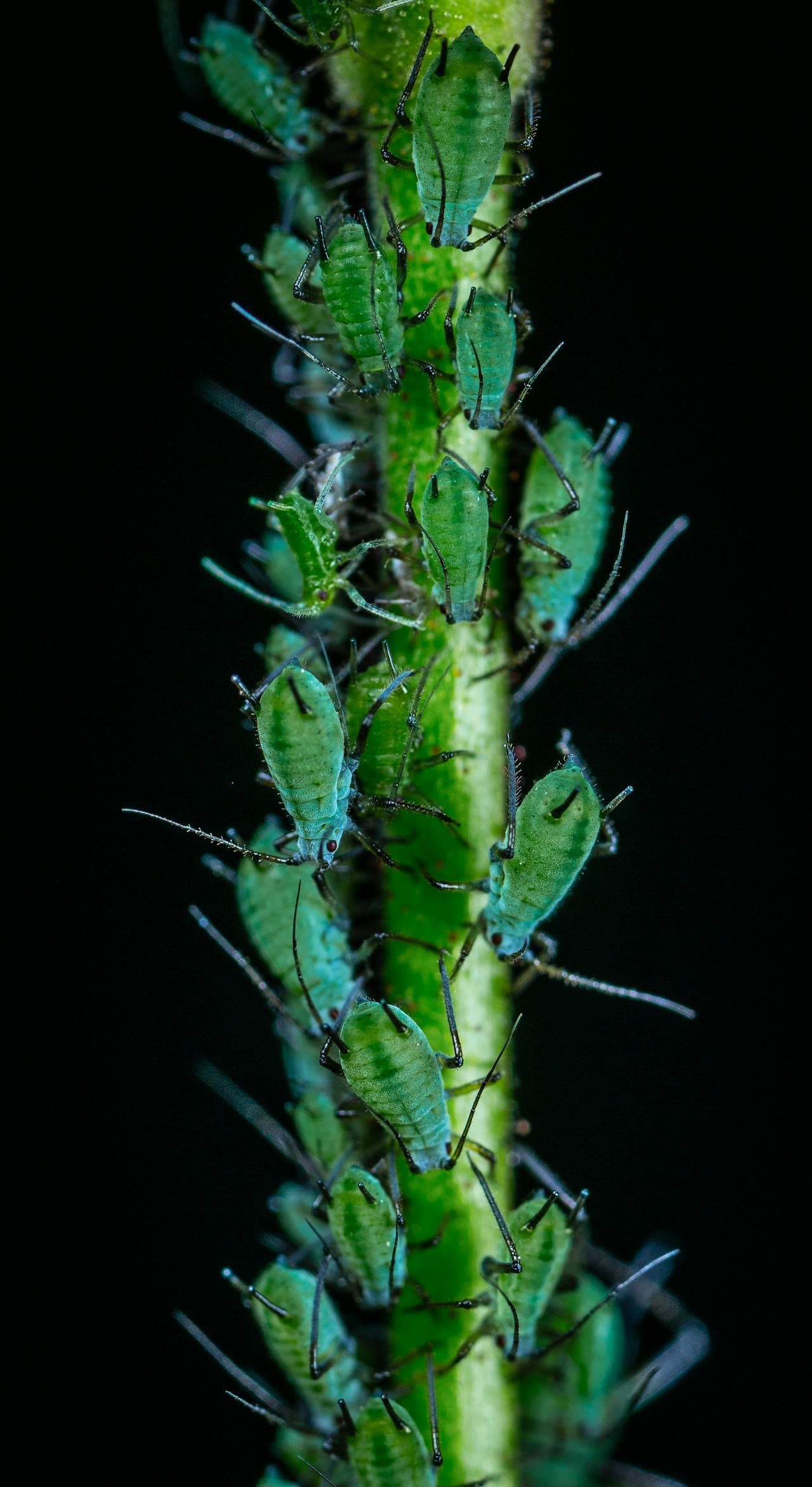
What you see: Clusters of small pear-shaped green, black, or pink insects on new growth and flower buds. Sticky honeydew follows.
Who they target: Fresh growth on almost anything. Common on herbs (basil especially), flowering houseplants, and bromeliads. More often an outdoor garden pest that hitchhikes inside on cut flowers or returning outdoor plants.
Treatment:Rinse off with a forceful stream of water. Insecticidal soap for follow-up. Aphids are the easiest pest on this list to control — they have no protective coating.
Quick decision tree
Webbing in leaf axils, stippled leaves
Spider mites. Rinse + insecticidal soap + humidity.
Tiny flies when you water
Fungus gnats. Dry out soil + BTI drench.
White cottony tufts in leaf joints
Mealybugs. Isopropyl alcohol on cotton swab + systemic if heavy.
Brown bumps stuck to stems, sticky leaves
Scale. Scrape off + horticultural oil.
Silvery streaks on leaves, small black dots
Thrips. Blue sticky cards + spinosad weekly.
Clustered pear-shaped bugs on new growth
Aphids. Water spray + insecticidal soap.
Sticky floors below plant
Any sap-sucking pest (aphids, scale, mealybugs, whiteflies). Check undersides.
Holes chewed out of leaves
Caterpillars or slugs. Hand-pick. Rare indoors.
Prevention: 5 habits that stop most infestations
- Quarantine new plants for 2 weeks. Keep every new plant in a separate room, inspect weekly, treat preemptively with insecticidal soap.
- Inspect weekly — focus on leaf undersides.Most pests live where you don’t look. A five-minute Saturday check catches problems early.
- Don’t overwater. Wet soil and soft stressed plants attract pests. Healthy plants resist.
- Wipe or rinse leaves monthly. Clean leaves = early pest detection + better photosynthesis + fewer spider mites.
- Rinse returning plants before bringing them inside. Plants that summered on the patio come back in with hitchhikers. Hose them down thoroughly, inspect for days, consider prophylactic treatment.
When to give up on a plant
If a plant has a severe pest infestation that keeps returning despite treatment, and you have other plants in the home, sometimes the compassionate choice is composting the infested plant to protect your collection. This is especially true for thrips infestations on common plants — a $15 pothos isn’t worth a 6-month battle that threatens a $200 collection. Make the call, bag the plant (don’t compost pest-infested plant material indoors), and start fresh.
Found this useful? Share it with someone who'd enjoy it.
Want to learn more?
Explore more plant care guides or find a nursery near you.
More plant care guides
Newsletter — early list
Get on the early list
We're putting together a slow, seasonal newsletter for prairie plant lovers. Drop your email and we'll send the first issue when it goes out. No filler, easy out.
Get on the list