American Vetch
Vicia americana
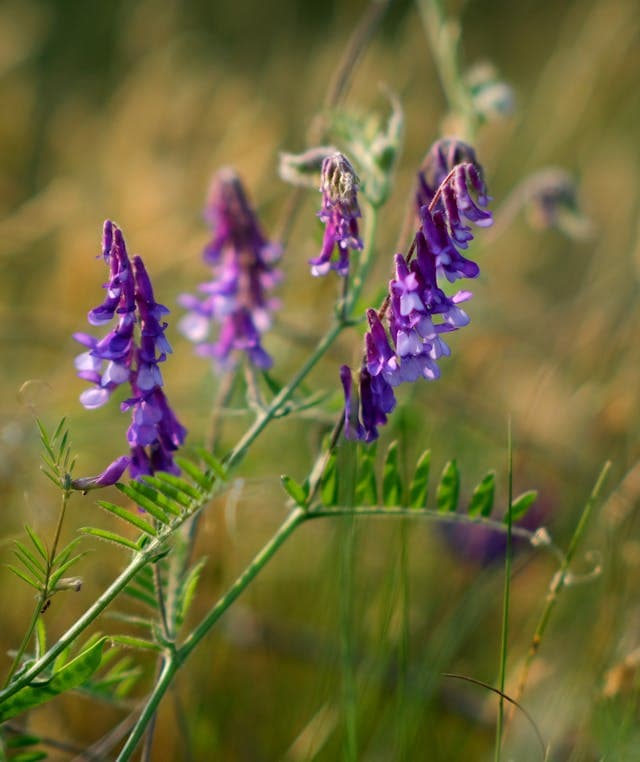
American vetch is a native climbing legume of Alberta's grasslands, parkland edges, and open woods, scrambling 30 to 80 cm through grass and shrubs by curling tendrils at the leaf tips. Clusters of two to nine pinkish-purple to violet pea flowers appear from late June through August, providing nectar for native bumble bees and serving as a larval host for the silvery blue butterfly. Like all legumes, vetch fixes nitrogen in root nodules, slowly enriching the soil where it grows. An excellent component of a meadow planting or naturalized pollinator strip; not for tidy borders, where its sprawling habit looks weedy. Reliably hardy throughout Alberta (Zone 2). Do not confuse with introduced Eurasian Vicia cracca (tufted vetch), which is more aggressive and considered weedy on the prairies; American vetch is more restrained and a native ecological asset.
Quick Facts
Distribution
Native across Alberta in grasslands, parkland, and open woods. Hardy throughout the province (Zone 2).
Light
Full sun to part shade.
Bloom Time
Late June through August
Soil
Adaptable. Tolerates lean to moderately fertile, well-drained soil. Prefers neutral to slightly alkaline pH.
Water
Low. Drought-tolerant once established.
Growing & Cultivation
Best Planting Time
Direct-sow fall (October) or spring after scarifying seed (nick or sand the hard seed coat) and inoculating with the appropriate Rhizobium for legume nitrogen fixation.
Propagation
Seed is standard. Scarify (file or sand a small notch in the seed coat) for reliable germination, then sow 5 mm deep in prepared soil. Self-seeds modestly once established.
Pruning / Splitting
None required. Mow or cut back in late fall if the patch needs tidying.
Spacing
Plant or thin to 30 cm; vines weave together in any case.