Sea Buckthorn
Hippophae rhamnoides
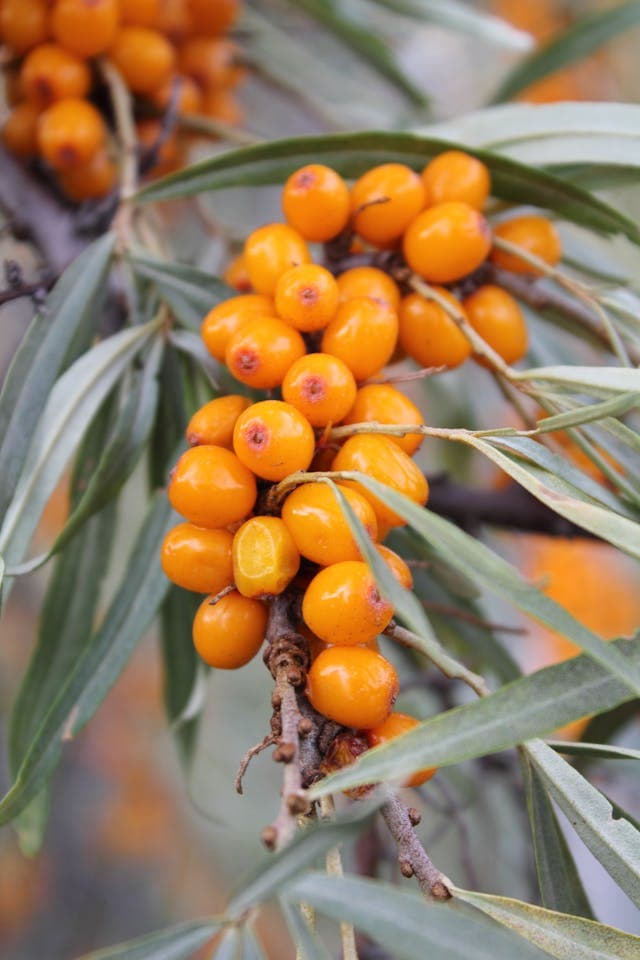
Sea buckthorn is a thorny, silver-leaved shrub from the cold steppes of Eurasia, now widely planted on the Canadian prairies as a windbreak, wildlife shrub, and superfruit crop. Tart, bright orange berries cling to the stems in dense clusters from late August through fall and are exceptionally rich in vitamin C, vitamin E, and unusual omega-7 fatty acids. The plant is dioecious (separate male and female bushes), so you need at least one male within about 6 m of every five or six females for pollination by wind. Sea buckthorn is extraordinarily tough: thrives in lean soil, fixes its own nitrogen, tolerates salinity and drought, and is hardy throughout Alberta. Two cautions for Edmonton planters: it suckers aggressively from a wide root system (do not plant near foundations or fences you might regret), and the bushes are armed with serious thorns that make harvest a long-sleeves-and-pruners job. Cultivars worth seeking out for prairie yards include 'Indian Summer' and the U of S-tested 'Sunny' and 'Russian Orange'.
Quick Facts
Distribution
Garden and farm shrub. Native to temperate Eurasia. Hardy to Zone 1; thrives across Alberta.
Light
Full sun. Will tolerate light shade but flower and fruit yield drop sharply with less than 6 hours of direct sun.
Bloom Time
Late April to mid-May (wind-pollinated; flowers are small and inconspicuous)
Soil
Almost anything well-drained. Tolerates lean, sandy, or gravelly soil and even mildly saline conditions. Fixes nitrogen through root-associated Frankia bacteria, so does not need rich soil. Avoid heavy waterlogged ground.
Water
Low. Drought-tolerant once established. Supplemental water during the first two seasons helps establishment; after that, prairie rainfall is usually enough.
Growing & Cultivation
Best Planting Time
Spring or fall. Bare-root plants establish well in early spring before bud break.
Propagation
Hardwood cuttings of named cultivars in late winter, or root suckers transplanted from established bushes (every shrub eventually produces dozens). Seed-grown plants are variable in sex ratio and fruit quality.
Pruning / Splitting
Mature bushes benefit from rejuvenation: remove the oldest 20 percent of stems each winter. Easier to harvest from a deliberately shaped bush than a wild thicket.
Spacing
2 to 3 m between bushes. One male per 5 to 6 females, all within roughly 6 m for wind pollination.
Always verify plant identification with multiple sources before consuming any wild plant. This information is for educational purposes only.