Zinnia
Zinnia elegans
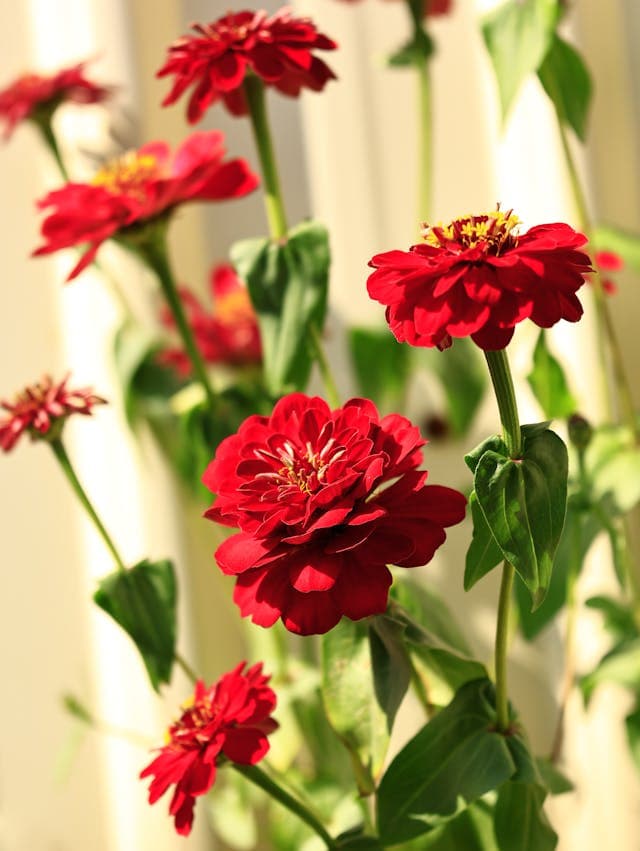
Zinnias are the bright workhorse cutting-garden annual: tough, heat-loving, fast from seed, and unmatched for a long succession of saturated colour from July through hard frost. Native to Mexico (domesticated by the Aztecs and named for German botanist Johann Gottfried Zinn). Modern hybrids span every colour except true blue: white, cream, yellow, orange, salmon, scarlet, magenta, lavender, lime green, deep purple, plus stripes and bicolours. Pollinator-friendly: open-centred single varieties (such as the Zahara, Profusion, and Old Mexico series) feed butterflies and native bees better than tight pom-pom doubles. For prairie cut-flower gardens, the Benary's Giant series ('Wizard of Oz', 'Pinkalicious', 'Lime') is the standard: 90 to 120 cm plants with 10 to 13 cm flowers on long sturdy stems. Zinnias germinate quickly in warm soil and resent transplanting, so direct-sow after late May. Powdery mildew can be an issue in humid years; choose mildew-resistant varieties (Profusion, Zahara) for low-maintenance plantings and give full sun and airflow.
Quick Facts
Distribution
Summer annual across Alberta. Native to Mexico.
Light
Full sun.
Bloom Time
July through hard frost
Soil
Average to rich, well-drained. Tolerates clay if amended.
Water
Moderate. Water at the base, not from above, to reduce powdery mildew.
Growing & Cultivation
Best Planting Time
Direct-sow late May after soil warms to 15 C, or start indoors 4 to 6 weeks before last frost and transplant gently after frost passes.
Propagation
Direct seed 5 mm deep, 15 to 30 cm apart depending on variety. Germinates in 5 to 10 days at 21 C.
Pruning / Splitting
Pinch the central growing tip when seedlings have 3 to 4 sets of true leaves to force branching and more flowers. Deadhead spent blooms for continuous flowering. Harvest cut flowers aggressively; the more you cut, the more they bloom.
Seed Collection
Let some flowers fully dry on the plant in September. Harvest dry seed heads, crumble apart, separate seed from chaff.
Spacing
15 to 20 cm for compact varieties, 30 cm for Benary's Giant types.
Always verify plant identification with multiple sources before consuming any wild plant. This information is for educational purposes only.