Bird of Paradise
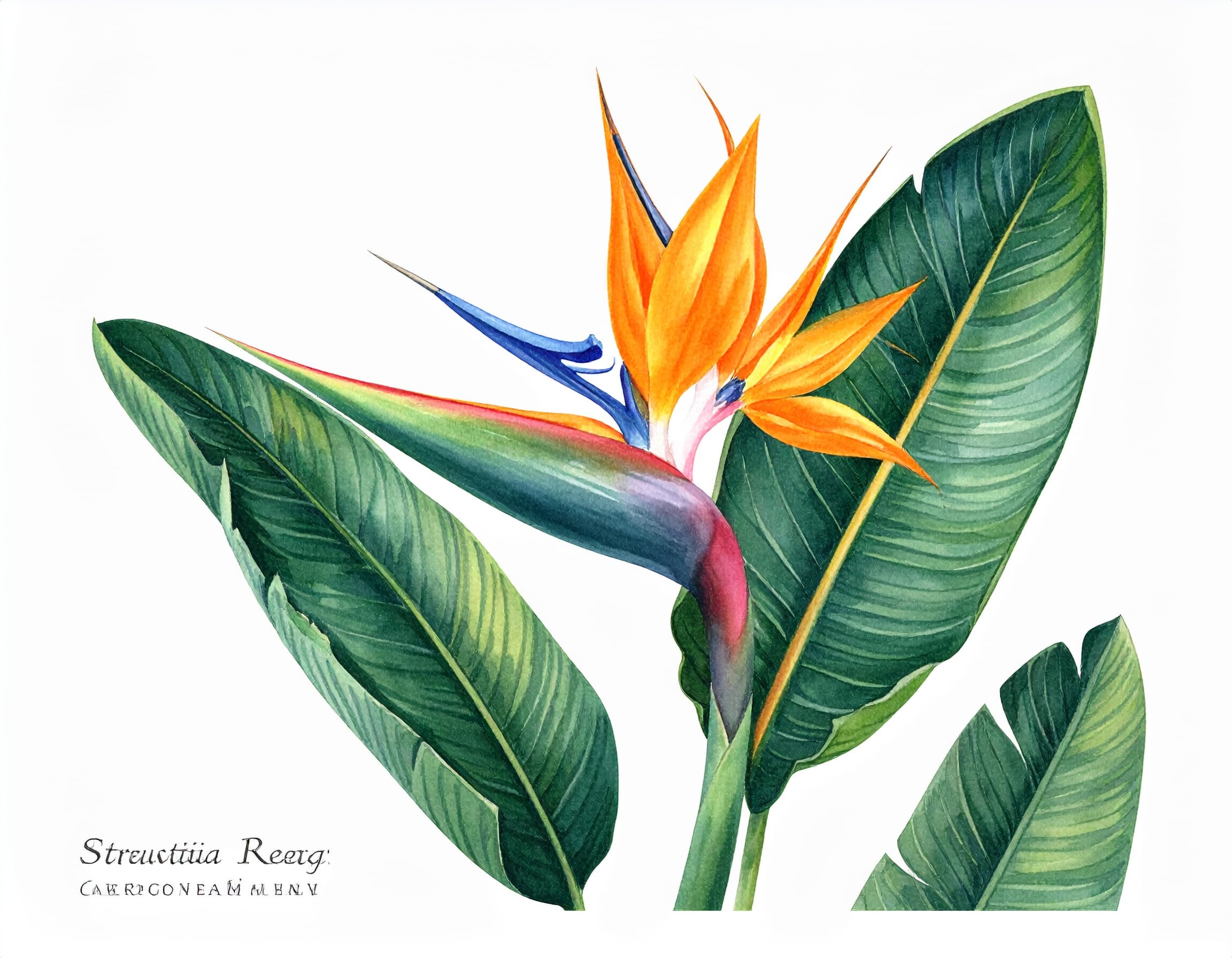
Strelitzia reginae
A dramatic South African evergreen with large paddle-shaped leaves and, on mature plants, unmistakable orange-and-blue crane-like flowers that gave the plant its common name. A slow grower that can eventually reach 5 to 6 feet indoors and twice that outdoors in tropical climates. Prefers a bright south or west window with several hours of direct sun. Anything dimmer and it stays alive but rarely blooms. Patience is part of the deal: most indoor specimens take 4 to 6 years to flower for the first time, and only after the plant has become genuinely root-bound. Crowded roots are the trigger that pushes the plant into bloom mode, so resist the urge to repot too often. Splits along the leaf midrib are normal in Strelitzia, not a sign of damage. The splits let wind pass through the leaves in their native habitat. Yellowing lower leaves usually mean either too much water or not enough light. Mature plants are heavy, so a wide terracotta pot or a weighted ceramic planter is essential to keep them from tipping. Wipe the broad leaves monthly with a damp cloth to clear dust and keep the stomata working.
Quick Facts
Distribution
Indoor (native to South Africa)
Light
Bright direct sun (4 or more hours daily for blooms)
Bloom Time
Occasionally indoors on mature root-bound plants
Soil
Chunky, free-draining mix: 60 percent quality indoor potting soil, 20 percent perlite or pumice, 20 percent orchid bark
Water
When the top 3 to 5 cm of soil is dry. Less in winter. Use room-temperature water and avoid letting the pot sit in standing water
Growing & Cultivation
Propagation
Does not grow from leaf or stem cuttings. Two reliable methods: division and seed. Division (faster, recommended) is done at repotting time: gently work the root ball apart, find natural separation points where 2 or 3 fans share their own root section, then cut through the dense rhizome with a clean sharp knife. Dust cut surfaces with cinnamon or sulphur powder, pot each division separately in fresh free-draining mix, and expect a few months of sulking before new growth resumes. Seed propagation is much slower (5 to 10 years to a flowering plant). Seeds need scarification and 24 hours of soaking before sowing in warm, moist soil. Germination is unreliable and can take 2 to 3 months
Repotting
Only every 2 to 3 years, and only pot up by one size at a time (about 5 cm / 2 inches wider). The plant prefers being root-bound and a too-large pot delays blooming. Best window is early spring as new growth resumes. Choose a pot with generous drainage holes. Hold off on fertiliser for about 6 weeks after repotting to let any disturbed roots recover
Pruning / Splitting
Remove fully-yellowed outer leaves at the base with a clean knife. Don't trim split or browned tips: cutting into healthy green tissue stresses the plant and leaves a permanent brown edge. New leaves emerge from the centre, so old outer leaves naturally complete their cycle and can be removed