Kale
Brassica oleracea var. acephala
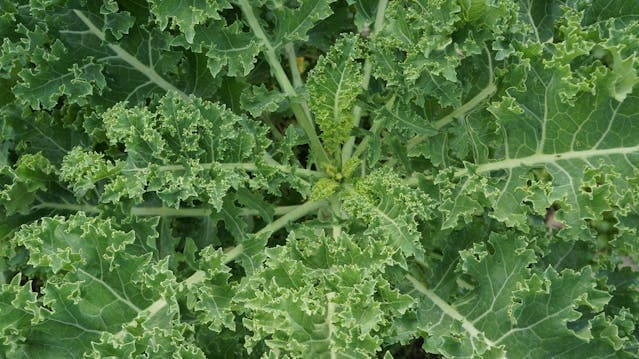
Kale is the prairie gardener's most forgiving leafy green: hardy through hard frost (and sweetens after one), tolerant of light shade, productive from early summer through deep fall, and willing to overwinter under snow in southern Alberta for an early spring harvest. Direct-sow in late April or May, harvest leaves from the bottom up as needed through the season, and the plants keep producing until temperatures drop below minus 10 C. The flavour transforms dramatically after a hard frost: starches convert to sugars and the leaves become noticeably sweeter. Reliable Edmonton varieties: Winterbor (curly green, the standard), Red Russian (flat, oak-leaf-shaped, mild), Lacinato or Dinosaur or Tuscan (dark blue-green strap leaves, the Italian classic), Redbor (deep purple curly). Watch for cabbage moth caterpillars (small green imported cabbageworm) and cabbage aphids; a fine mesh row cover from planting through harvest prevents both. Kale finishes its life cycle the second spring as a biennial: it bolts to a 1 m yellow flowering stalk in May, which is itself edible as a 'kale rabe' before the buds open.
Quick Facts
Distribution
Cool-season annual / biennial across Alberta. Cultivated form of wild cabbage native to coastal Europe.
Light
Full sun to part shade. Tolerates more shade than most vegetables.
Bloom Time
Second year (biennial), May to June yellow brassica flowers
Soil
Rich, deep, well-drained loam with high organic content. Heavy feeder; compost or aged manure at planting.
Water
Moderate to high. Consistent moisture for tender leaves; stressed plants get bitter.
Growing & Cultivation
Best Planting Time
Direct-sow late April to mid-May for summer harvest, or mid-July to early August for fall and overwintered crops. Indoor starts also work; transplant after frost risk.
Propagation
Direct seed 5 mm deep, 30 to 45 cm apart after thinning. Open-pollinated varieties save seed true through their biennial cycle.
Pruning / Splitting
Harvest leaves from the bottom up, leaving the growing crown intact. Plants produce continuously through the season. Remove yellowing lower leaves to discourage cabbage aphids.
Seed Collection
Overwinter a few plants under heavy mulch. They bolt and flower in May. Allow seed pods to brown on the plant in July, harvest, dry indoors, store cool. Brassicas cross-pollinate readily; isolate if you grow multiple types.
Spacing
30 to 45 cm.
Always verify plant identification with multiple sources before consuming any wild plant. This information is for educational purposes only.