Alberta Xeriscaping: Drought-Tolerant Native Plants for Dry Yards
Quick Care Summary
Alberta summers are getting hotter and drier. Calgary averaged 38 days over 30°C in 2023 and 2024; water restrictions now arrive most summers. A xeriscape — a garden designed to thrive on rainfall alone once established — isn’t just a water-saving convenience anymore; it’s becoming the sensible default.
The word “xeriscape” (from Greek xeros, dry) was coined in Denver in the 1980s. It doesn’t mean cactus and gravel — it means matching plants to the water your site actually receives. Alberta’s native prairie, foothills, and montane flora are the perfect palette. They evolved here, they know how to handle the dry summers, and they support pollinators no Eurasian perennial can match.
The seven principles of xeriscaping
- Plan first. Group plants by water need (hydrozoning). Keep thirsty plants (vegetables, fruit trees) near the house; put drought-tolerant natives in the outer zones.
- Improve the soil — but not the way you think. For xeriscape beds, mix in coarse sand and pea gravel to improve drainage, not compost. Native plants want lean soil.
- Shrink the lawn. Turf grass is the biggest water user. Native groundcovers and mulch replace lawn with 1/10th the water use.
- Choose the right plants. Alberta-native drought-tolerant species are ideal (lists below).
- Water deeply, infrequently. Five minutes every day trains roots to stay shallow. Twenty minutes once a week drives roots deep where drought can’t reach them. Use drip irrigation.
- Mulch. A 5–8 cm layer of wood chips, pea gravel, or shredded bark cuts evaporation dramatically.
- Maintain lightly. Xeriscapes need less watering, less mowing, less fertilizing. Overdoing any of these actually hurts drought-adapted plants.
Star performers — the bulletproof natives
Wildflowers & perennials
- Blanket Flower— red-orange-yellow daisies, prairie classic, thrives on poor soil.
- Wild Blue Flax— sky-blue flowers on wiry stems, self-seeds cheerfully.
- Purple Prairie Clover— nitrogen-fixing legume, bee magnet.
- Common Yarrow— tough as nails, tolerates poor dry soil.
- Dotted Blazing Star— vertical purple spikes, monarch favourite.
- Prairie Sage— silver-grey aromatic groundcover, ceremonial plant.
- Prairie Smoke— spring pink flowers, feathery seed plumes.
- Harebell— delicate blue bells, rock garden star.
- Prairie Crocus— earliest spring bloom, never transplant from wild.
- Smooth Aster— late-season blue blooms feed migrating monarchs.
Native grasses
- Blue Grama Grass— excellent low-water lawn alternative.
- June Grass— small bunchgrass, foothills ecotype.
- Rough Fescue— keystone prairie grass, slow to establish but long-lived.
- Little Bluestem— spectacular mahogany fall colour.
Shrubs
- Wolf Willow— silver foliage, intensely fragrant late-spring flowers, N-fixing.
- Buffaloberry— tart edible berries, nitrogen-fixing.
- Saskatoon Berry— edible fruit, spectacular spring bloom, drought-tolerant once established.
- Creeping Juniper— evergreen groundcover for dry slopes.
- Common Juniper— evergreen structure year-round.
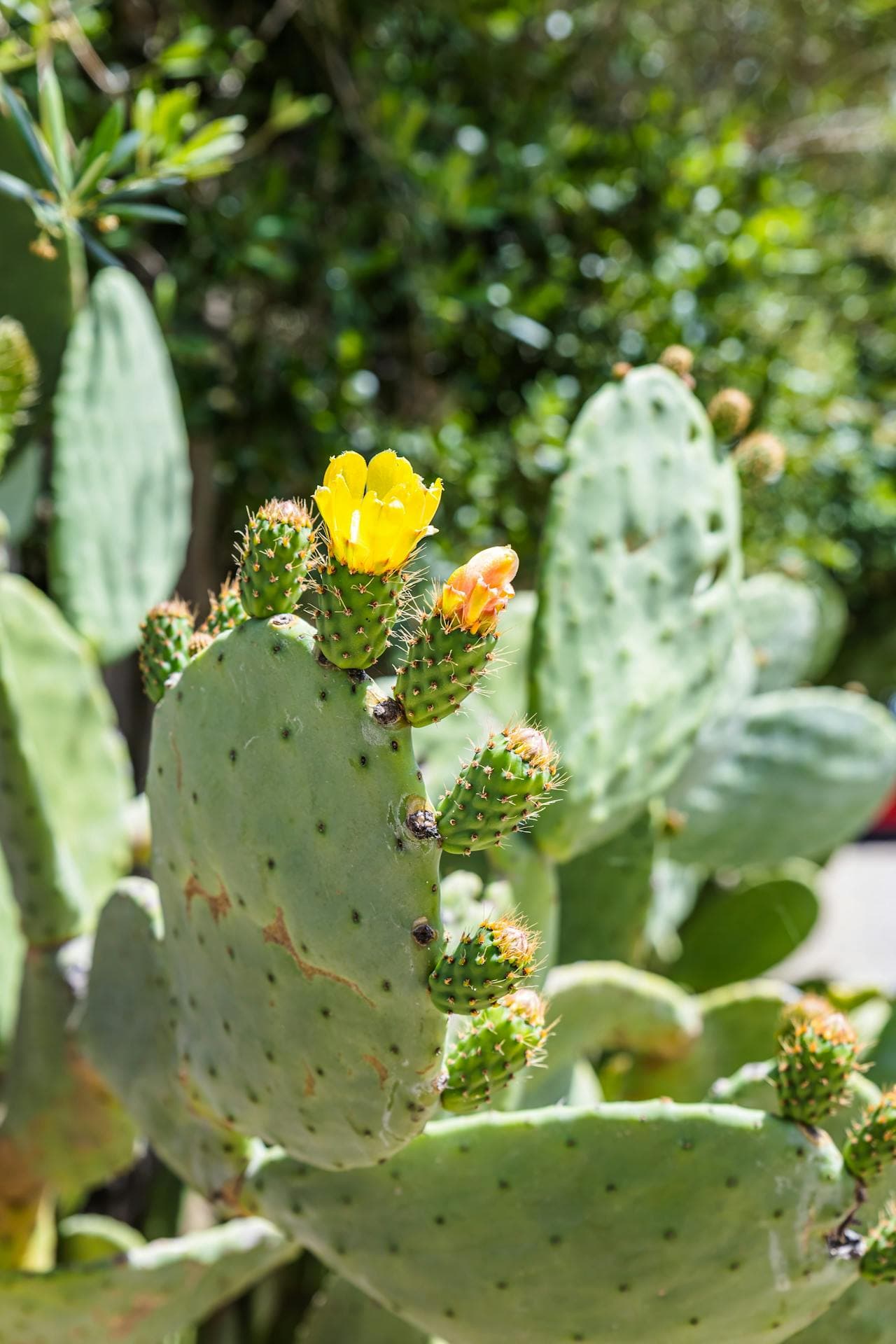
- Prickly Pear Cactus— yes, Alberta has native cactus. Spectacular June yellow flowers.
Sample xeriscape: a sunny dry back corner
Here’s a design for a 3 m × 4 m south or west-facing corner — the type of hot dry spot where lawn refuses to grow:
- Back layer (anchor): 1 Saskatoon Berry (2 m mature height) or 1 Wolf Willow
- Middle layer: 3 Blanket Flower, 3 Purple Prairie Clover, 3 Dotted Blazing Star
- Front layer: 5 Wild Blue Flax, 3 Prairie Smoke, 5 Harebell
- Accent: 1–2 Prickly Pear Cactus clumps at the sunniest corner
- Groundcover: Bearberry (Kinnikinnick) or Creeping Juniper as living mulch
- Mulch: 5 cm pea gravel between plants to conserve moisture and suppress weeds
Expected water use after establishment: deep soak once every 2–3 weeks in July/August, nothing in spring or fall rain-fed. Compared to the same area in turf grass: a reduction of roughly 85%.
The establishment year: counterintuitive rules
Even native drought-tolerant plants need regular watering for the first year while they develop root systems. Water deeply once a week the first summer, dropping to every 2 weeks the second summer, then stopping scheduled watering entirely in year 3. Don’t fertilize — native plants in rich or over-watered beds grow floppy, flower less, and die younger.
Common mistakes
- Over-amending soil with compost. Native drought-tolerant plants want lean soil. Too-rich soil produces weak floppy plants.
- Mulching too thin or too thick. Aim for 5–8 cm. Under 3 cm doesn’t hold moisture; over 10 cm suffocates plants.
- Planting too close together. Drought-tolerant natives need airflow. Follow mature-size spacing.
- Continuing to water in year 3+. Mature xeriscape plants resent excess water; overwatered crowns rot.
- Using landscape fabric under gravel mulch. Becomes a nightmare in year 4 when debris breaks down on top and weeds seed in from above. Skip it; use cardboard under thick mulch instead.
Where to source plants
Alberta has several specialized native plant nurseries worth knowing. Check our nursery finder for current listings. When buying: ask whether the stock is seed-propagated from Alberta genetic sources (best) or from out-of-province seed (still fine, just slightly less adapted). Avoid any nursery that can’t tell you the source — and never, ever buy “wild-collected” plants.
Found this useful? Share it with someone who'd enjoy it.
Want to learn more?
Explore more plant care guides or find a nursery near you.
More plant care guides
Newsletter — early list
Get on the early list
We're putting together a slow, seasonal newsletter for prairie plant lovers. Drop your email and we'll send the first issue when it goes out. No filler, easy out.
Get on the list